Imagine being responsible for the commercial future of one of the biggest football clubs in the world and deciding that the most valuable advertising space you own shouldn’t make you a penny.
In fact, you’re going to pay for the privilege of giving it away.
It sounds like the sort of decision that would have a modern football finance director reaching for the emergency whisky. Yet in September 2006, that’s effectively what Barcelona did.
At the time, the Catalan giants had Ronaldinho, Samuel Eto’o, a teenage Lionel Messi and a newly won Champions League trophy. They were one of the most recognisable teams on the planet, playing football that millions wanted to watch.
Their shirts, however, were about to become famous for something that had nothing to do with the players wearing them.
The Shirt That Changed During the Season
Barcelona began the 2006/07 season with something that had become almost unique among Europe’s biggest clubs: no sponsor across the front of their shirts.
It wasn’t an oversight. Since their foundation in 1899, Barcelona had resisted conventional front-of-shirt sponsorship, despite the enormous sums available to a club of their stature.
Then, on 7 September 2006, president Joan Laporta travelled to the United Nations headquarters in New York to announce an agreement with UNICEF.
Five days later, when Barcelona faced Levski Sofia at the Camp Nou in the Champions League, the famous blue and red stripes carried a front-of-shirt logo for the first time in the club’s history.
There was just one rather unusual detail.
UNICEF wasn’t paying Barcelona.
Barcelona was paying UNICEF.
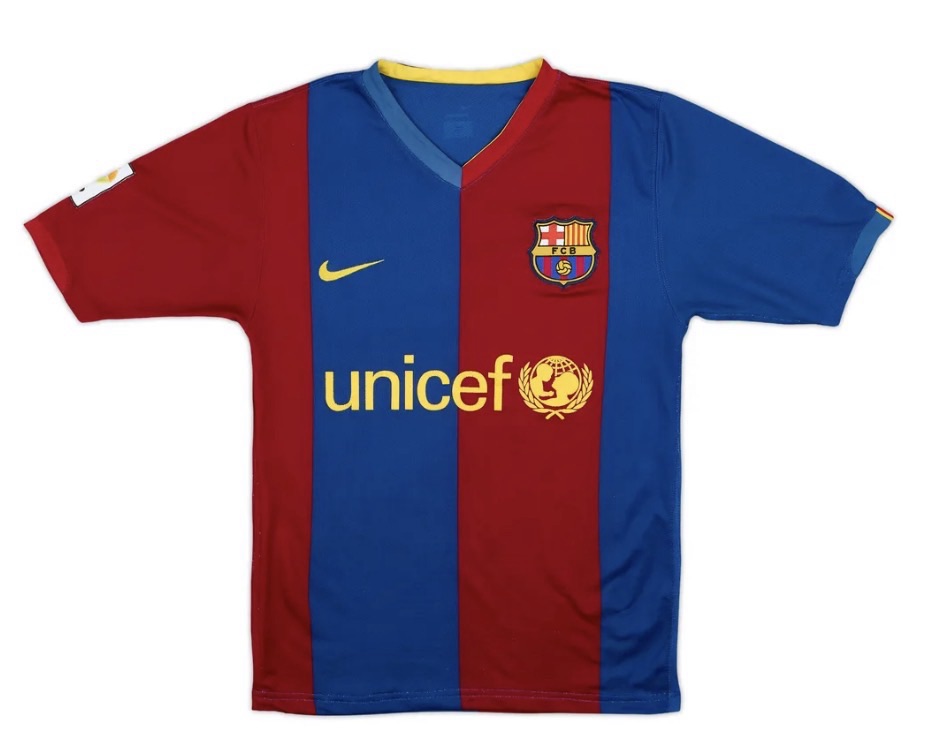
The agreement committed the club to donating at least €1.5 million annually for five years, supporting programmes for vulnerable children around the world. The initial focus was on children affected by HIV/AIDS in Swaziland, now known as Eswatini.
Barcelona also agreed to promote UNICEF through the worldwide visibility of its football team.
In an era when clubs were increasingly selling every available piece of advertising space, Barcelona had turned the usual arrangement completely upside down.
It wasn’t a sponsorship deal in the traditional commercial sense. It was a charitable partnership, with the club using its most valuable sporting asset to promote something beyond football.
Laporta presented it as a reflection of the club’s famous motto, Més que un club, or More than a club.
For once, that slogan was being backed by a substantial financial commitment.
Why Barcelona Could Afford to Be Different
For decades, Barcelona had resisted putting a commercial sponsor on their shirts. While other European giants advertised everything from electronics manufacturers to airlines, Barcelona’s famous stripes remained largely untouched.
The badge, the colours and the players were considered enough.
There was also a strong sense that Barcelona represented something beyond the football pitch. Its Catalan identity, membership structure and history gave the club a different relationship with its supporters.
That didn’t mean Barcelona was somehow immune to commercial pressures. Nike was already manufacturing the shirts, and the club was very much part of the modern football economy.
But the absence of a front-of-shirt sponsor had become a distinctive part of Barcelona’s identity.
The UNICEF agreement allowed the club to change that tradition without appearing to abandon it.
Instead of introducing a commercial advertiser, Barcelona could argue that it was using its global influence for a humanitarian purpose.
The contrast with today’s football shirts is striking. As we explored in How Many Sponsors Is Too Many on a Football Shirt?, clubs now face a difficult balance between generating commercial income and protecting the appearance and identity of their kits.
Barcelona had faced a different question in 2006: what if the most valuable space on the shirt could be used for something other than revenue?
The timing helped enormously.
Frank Rijkaard’s side had just beaten Arsenal in the Champions League final. Ronaldinho was one of football’s biggest stars, while Messi was beginning the journey that would make him arguably the greatest player of all time.
There could hardly have been a better moment to put a message in front of millions of football supporters.
And unlike most sponsorship announcements, the important part wasn’t the amount of money Barcelona would receive.
It was what the club was prepared to give away.
The Decision That Changed Everything
For five seasons, UNICEF occupied the front of Barcelona’s shirts.
Those years included Pep Guardiola’s extraordinary rise as manager, the 2009 treble and the 2011 Champions League triumph over Manchester United.
Some of the finest football ever played was accompanied by a logo that wasn’t there to generate sponsorship revenue.
But football’s commercial landscape was changing quickly, and Barcelona eventually changed with it.
In December 2010, the club announced a five-year agreement with the Qatar Foundation, reportedly worth €150 million, beginning with the 2011/12 season.
Suddenly, the financial difference was enormous.
Barcelona would go from donating €1.5 million annually as part of its UNICEF partnership to receiving around €30 million a year from its new principal shirt sponsor.
UNICEF wasn’t immediately removed altogether. Its logo moved to the back of the shirt, beneath the player’s number, and the charitable partnership continued.
The front of the shirt, however, had entered a different era.
The decision was controversial among supporters who believed Barcelona had surrendered something important. Others argued that the club couldn’t reasonably ignore such substantial commercial income while trying to compete with Europe’s richest teams.
Both arguments had merit.
Barcelona was still more than a club to its supporters, but it was also an increasingly expensive football operation.
From UNICEF to Spotify
The years that followed demonstrated just how valuable Barcelona’s shirt had become.
Qatar Foundation was succeeded by Qatar Airways, then Rakuten, and eventually Spotify.
Each agreement belonged to a football economy in which shirt sponsorship was no longer simply about placing a company name on a player’s chest.
Clubs were selling access to enormous global audiences, social media attention and an association with some of the most famous footballers in the world.
Barcelona’s partnership with Spotify even brought temporary changes to the shirt itself, with artist branding replacing the usual sponsor logo for selected matches.
The shirt had become an advertising platform capable of generating headlines independently of the football.
Of course, commercial branding doesn’t always have to dominate a football shirt. We recently highlighted Beerschot’s 2026/27 away kit, where sponsors adopted the club’s purple colour scheme rather than forcing their usual branding onto the design.
It’s a small but revealing example of how commercial partnerships can work with a shirt rather than against it.
Barcelona’s 2006 arrangement went considerably further. Instead of negotiating how a sponsor should appear, the club had chosen an organisation whose presence was intended to promote a cause.
Could It Happen Again?
There’s a temptation to look back at the UNICEF years as evidence that football was somehow purer twenty years ago.
That would be stretching things.
Barcelona wasn’t operating outside the commercial world, and the partnership also helped reinforce its international image. Doing something worthwhile and benefiting reputationally from it aren’t mutually exclusive.
The UNICEF relationship continued long after the logo left the front of the shirt. Barcelona’s Foundation went on to support projects involving education, sport and child protection.
In 2022, Barcelona also began a humanitarian partnership with UNHCR, using shirt branding to raise awareness of refugees and displaced people.
So the idea of using football’s global reach for something beyond commercial gain hasn’t disappeared entirely.
But the contrast with 2006 remains difficult to ignore.
Today, a major shirt sponsorship announcement is usually accompanied by figures explaining how much money a club will receive.
Barcelona’s announcement was unusual because the money was travelling in the opposite direction.
The club knew its shirt was commercially valuable. It had already resisted the usual sponsorship arrangements for decades.
Rather than sell that space immediately, Barcelona chose to use it for something else.
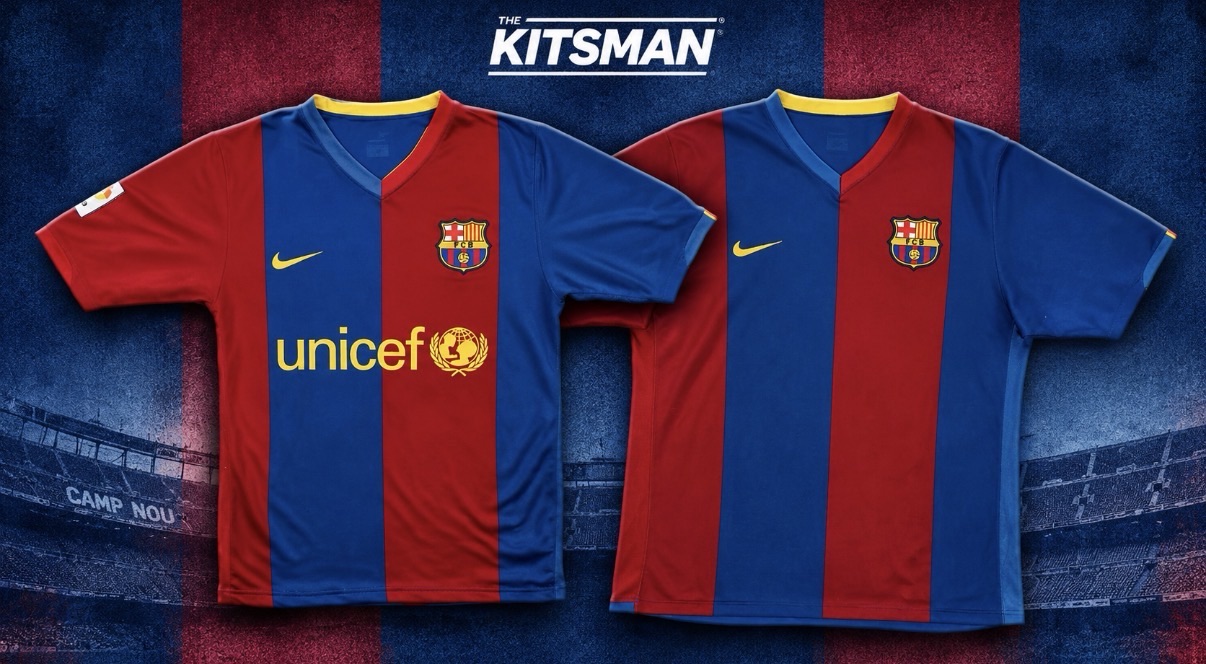
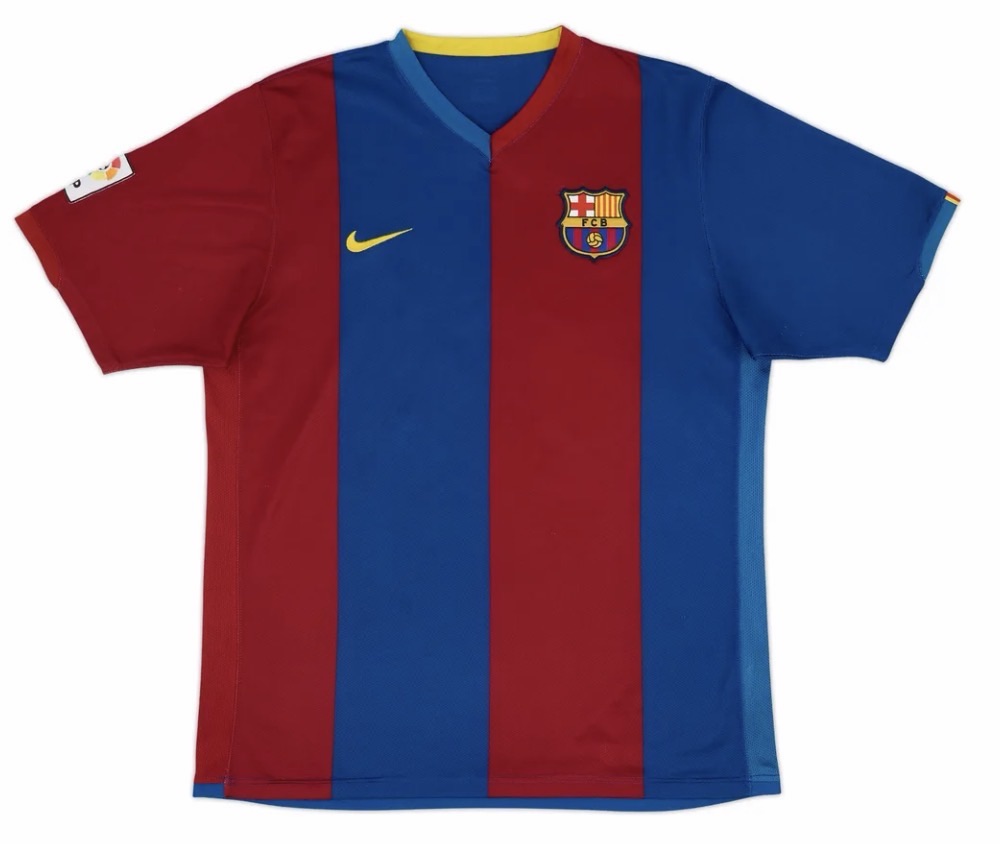
There’s a curious reminder of that decision in the original 2006/07 shirts themselves. Because the UNICEF agreement was announced after the season had started, the team initially played without the logo. That helps explain why genuine sponsorless examples of the 2006/07 home shirt can still be found on the collectors’ market.
Two versions of the same season’s shirt tell the story of a remarkable change in Barcelona’s history.
Those shirts were worn during the early years of Messi’s career, with Ronaldinho, Xavi and Iniesta helping shape one of the most celebrated periods in the club’s history.
But the UNICEF logo tells another story entirely.
For a few remarkable seasons, one of football’s most valuable advertising spaces wasn’t being sold to the highest bidder.
Barcelona was paying to put it there.
More from The Kitsman
How Many Sponsors Is Too Many on a Football Shirt?
Football shirts are carrying more commercial branding than ever. We examine where clubs should draw the line between revenue and identity.
Beerschot Away Kit 2026/27 Shows Why Sponsors Should Adapt to the Shirt
A striking example of how sponsors can complement a shirt’s design rather than overwhelm it.
Further reading
- FC Barcelona: History of the UNICEF partnership
- UEFA: Barça shirts to support UNICEF, September 2006
- The Guardian: Barça take the moral high road
- El País: Barcelona’s UNICEF logo to debut against Levski Sofia
For more football stories, shirt history and opinion, follow The Kitsman on X and The Kitsman on Instagram.