There was a time when getting a new football shirt felt like a proper occasion. You’d spend weeks asking for one, finally get your hands on it and wear it until the sponsor started peeling off.
They weren’t cheap back then either. But somewhere along the way, £85 for a football shirt became something we’re apparently supposed to consider perfectly normal.
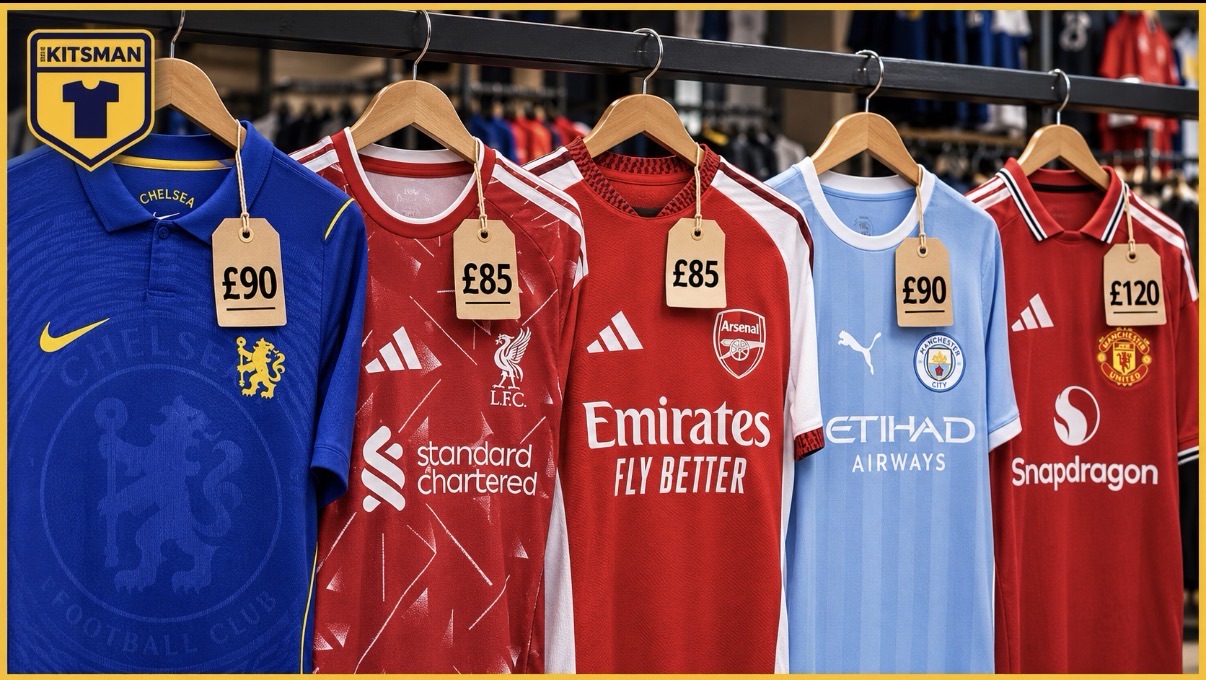
Manchester United, Liverpool, Arsenal and Newcastle United all have 2026/27 adult replica shirts priced at £85. Chelsea’s Nike shirt is £90.
That’s before you start thinking about a name on the back.
And we’re not talking about the shirts the players actually wear. Those are generally sold as more expensive authentic versions, with some reaching £120 or £135.
So when exactly did a standard football shirt become a premium purchase?
£90 for a Football Shirt. Really?
There’s a familiar defence whenever shirt prices come up. Everything costs more these days.
Fair enough. Manufacturing, transport, wages and running a business all cost money. Nobody seriously expects a shirt to cost what it did in 1995.
But that doesn’t mean every price increase is automatically reasonable.
Research reported by The Guardian earlier this year found that England’s replica shirt had risen from £45 in 2010 to £90 in 2026. That’s a doubling of the price in sixteen years, significantly outpacing general inflation.
You can appreciate improvements in fabrics, printing and manufacturing without believing that a polyester football shirt represents £90 of value.
And perhaps that’s the uncomfortable bit. Football shirts are priced according to what supporters are prepared to pay, not simply what it costs to make them.
That’s how most businesses work, of course. But most businesses don’t have customers who have supported their brand since childhood and would never dream of switching to a competitor.
You can’t exactly tell a lifelong Liverpool supporter to buy an Everton shirt because it’s cheaper.
The Problem With the ‘Authentic’ Shirt
One of the stranger developments in recent years has been the distinction between replica and authentic shirts.
For decades, supporters bought what they understood to be the team’s shirt. It might not have been identical to the players’ match equipment, but it looked the part.
Now manufacturers increasingly offer two versions. The standard replica and a more expensive player-style edition, often featuring different materials, construction and fit.
There’s nothing inherently wrong with giving people a choice. Plenty of collectors appreciate those details.
But the terminology is fascinating.
If the £85 shirt is the replica and the £120 shirt is the authentic version, what exactly are supporters buying for their £85?
It’s a clever way of creating another level of desirability around a product that was already expensive.
And judging by how established these ranges have become, it’s clearly a model the industry is comfortable with.
The Supporters Who Actually Pay
It’s easy to dismiss complaints about football shirt prices with the argument that nobody has to buy one.
Technically, that’s true.
But football clubs aren’t selling ordinary clothes to ordinary customers. They’re selling something tied to family traditions, childhood memories and a sense of belonging.
Think about a parent taking two children to the club shop before the start of a season. One wants the home shirt, the other wants the away. The parent quite fancies one too.
Suddenly, you’re looking at a bill running into hundreds of pounds, potentially before adding shorts, socks or printing.
We’ve already discussed whether clubs are releasing too many kits, but there’s a separate issue here.
Even buying just one shirt has become a significant expense.
And while collectors might happily spend £100 on something unusual, the average supporter buying their club’s home shirt isn’t necessarily looking for a luxury fashion purchase.
They just want to wear their team’s colours.
Perhaps We’ve Helped Create the Problem
Here’s where football shirt enthusiasts, ourselves included, probably deserve some scrutiny.
We celebrate releases, debate designs, share photographs and occasionally treat a new shirt like the unveiling of a priceless work of art.
A particularly attractive design can sell out quickly. A limited edition becomes desirable precisely because people are worried about missing out.
We’ve helped turn football shirts into collectable objects, and manufacturers have understandably noticed.
That doesn’t mean enjoying football shirts is the problem. It’s a brilliant part of football culture, and some of today’s designs are genuinely worth celebrating.
But there’s a difference between appreciating a beautiful shirt and accepting that every beautiful shirt should command a premium price.
Perhaps the most telling thing is how little surprise there is when another £85 shirt appears.
The price barely makes the conversation anymore. We’re too busy discussing the collar.
And that’s probably exactly where the industry wants us.
Football shirts will never be cheap enough for everyone. But when £90 becomes an ordinary price for an ordinary replica shirt, it’s reasonable to wonder whether supporters are getting better products or whether clubs and manufacturers have simply become better at selling them.
At what price would you finally say a new football shirt is too expensive?
For more football shirt history, kit releases and opinions, follow The Kitsman on X and Instagram.